Friday, March 11, 2016

Spring Is Here, I'm So Excited I Wet My Plants

Family Farmers in the Making


Spring Is Here, I'm So Excited I Wet My Plants...no spelling error here peeps. :) Back in January, I scored some seeds and organic biodegradable pots from the dollar store! 25 cents for each pack of seeds…YES please.


So, today the girls and I began our first adventure with “farming” as they call it. So cute, right? 

Here is how we did it:

1. Separate all seedling packets by type (flower, plant, veggie, fruit, etc), then by sow depth and lastly by water/sun needs. (Total cheeser faces)


2. This was fun for the girls. I simply filled two large kennel bowls with soil and let the girls have a hay day with filling all of the pots. Messy! But fun. I would recommend doing this outside or in your garage. My kitchen counter may not have been the best place to host today's project.


3. Once pots are all filled, it's time to start with pile 1: which was our 1/4 inch sew depth, veggies. Create 1/4 inch holes in soil with fingers- great distance quest for the littles. :) 

4. Place 1-3 seedlings in each whole/pot and cover lightly and pat down with additional soil. Remember not to add too much to the top of the pot. You don't want to exceed recommended sew depth.

5. Place completed pots in a rubbermaid container.


6. Repeat for all seedling packages. 

7. Water lightly and place rubbermaid tubs in a warm, sunny place in your home. (We have been moving the tubs outside during these oddly warm days that we have been having and then bringing them back in at night...seems to be working out wonderfully.)


8. After the first water (with a watering can), I recommend using a spray bottle going forward until seedlings have sprouted. It helps to not disrupt the soil. Use spray bottle 2-3 times a day. Remembering to keep soil moist. 


So much fun and the such a great little project for little helping hands. I will update with images when they sprout, and once we transfer outside. Stay tuned. :)

Wednesday, March 9, 2016

Life Series Part I

Life Series Part I: Health Care


Did you wake up one day and realize that you are all of a sudden responsible for you. Your actions? Your life? It's part of the very sad and tragic circle of life. So, what does "adulting" actually mean? Let's take a look: College, Banking, Career (applications, resumes, job hunting), Dr. Appointments, Bills, Insurance (health, car, home, etc), Taxes...the list goes on and on and on.

Starting a series on How To Handle Life seemed appropriate considering the number of people who simply just do not get it. ***I was fortunate and had the luxury of a husband (boyfriend at the time) when these issues came up who handled them...while teaching me along the way. I have encountered so many people however, that either weren't that lucky, did not have the learning opportunities (family or school wise), or simply never cared to figure it out themselves. Thus, the reason for this awesome series!

I will be covering a myriad of topics to help you or someone you know (friend, sibling, child) navigate this treacherous thing we all call adulthood.


Lesson 1: Health Insurance

Everyone at this point has heard of ObamaCare. And whether or not you like it, it's here to stay...well, hahaha for the next year or so at least. So, save yourself the heartache, the penalty fees and healthcare struggle in general and let me explain a little more in depth about what ObamaCare is and how to obtain it. The in's and out's of the new healthcare system are tricky, but here is some very valuable info. Enjoy.


What is ObamaCare?
The official name for “ObamaCare” is the Patient Protection and Affordable Care Act (PPACA), or Affordable Care Act (ACA) for short.
• The ACA was signed into law to reform the health care industry by President Barack Obama on March 23, 2010 and upheld by the Supreme Court on June 28, 2012.
• ObamaCare’s goal is to give more Americans access to affordable, quality health insurance and to reduce the growth in U.S. health care spending.• The Affordable Care Act expands the affordability, quality, and availability of private and public health insurance through   consumer protections, regulations, subsidies, taxes,insurance exchanges, and other reforms.• January 31st, 2016 was your last chance to get 2016 coverage at Healthcare.Gov without qualifying for Special Enrollment. 

Now that you understand what ObamaCare is, let's discuss a few key topics:

1. Why do you need Health Care/ObamaCare?


The obvious reason, would be to protect you and your loved ones from unseen catastrophic events. But it's not just catastrophic events that can throw your family into a financial crisis. Simple things like strep throat, the flu, a broken arm, having a baby...and let's face it-if you have kids and no insurance, you are setting yourself up for major failure! Anyone who has children knows that the doctor's office becomes your second home. 

2. What are the repercussions for not having Health Care/ObamaCare?

If you can afford health insurance but choose not to buy it, you must pay a fee called the individual shared responsibility payment. (The fee is sometimes called the "penalty," "fine," or "individual mandate.")

The Fee for not having Health Insurance in 2016...
The fee is calculated 2 different ways – as a percentage of your household income, and per person. You’ll pay whichever is higher.
Percentage of Income:
  • 2.5% of household income
  • Maximum: Total yearly premium for the national average price of a Bronze plan sold through the Marketplace
Per Person:
  • $695 per adult
  • $347.50 per child under 18
  • Maximum: $2,085
Paying the fee:
  • Using the percentage method, only the part of your household income that’s above the yearly tax filing threshold ($10,150 for individuals, $20,300 for couples filing jointly in 2014, the most recent year available) is counted.
  • Using the per-person method, you pay only for people in your household who don’t have insurance coverage.
  • If you have coverage for part of the year, the fee is 1/12 of the annual amount for each month you (or your tax dependents) don’t have coverage. If you’re uncovered only 1 or 2 months, you don’t have to pay the fee at all. Learn about the “short gap” exemption.
  • You pay the fee when you file your federal tax return for the year you don’t have coverage.
3. What are the costs associated with Health Care/ObamaCare?


First, let's take a look at the different plans associated with ObamaCare:


1. Bronze- Bronze plans tend to have the lowest premiums of all Metal Plans. That is because they only have to provide 60% of cost sharing on average. Bronze plans provide an average cost sharing value (known as Actuarial Value AV) of 60%. This means that a Bronze plan must cover an average of 60% of all that plans enrollees covered out-of-pocket costs. This does not mean that 60% of actual costs will be covered for any one given person. In fact, a small minority of policy holders will account for the majority of costs. So actuarial value should always be looked at as a sign of how good a plan’s cost sharing is, not as a literal amount. Literal cost sharing amounts can be found on a plan’s benefit sheet.


2. Silver- Silver Plans are the marketplace standard plan. The second lowest cost Silver plan in a state is used as the benchmark plan when determining subsidies.

Silver plans provide an average cost sharing value (known as Actuarial Value AV) of 70%. This means that a Silver plan must cover an average of 70% of all that plans enrollees covered out-of-pocket costs (based on a standard population). This does not mean that 70% of actual costs will be covered for any one given person. In fact, a small minority of policy holders will account for the majority of costs. So actuarial value should always be looked at as a sign of how good a plan’s cost sharing is, not as a literal amount.
3. Gold- Gold plans provide an average cost sharing value (known as Actuarial Value AV) of 80%. This means that a Silver plan must cover an average of 80% of all that plans enrollees covered out-of-pocket costs. This does not mean that 80% of actual costs will be covered for any one given person. In fact, a small minority of policy holders will account for the majority of costs. So actuarial value should always be looked at as a sign of how good a plan’s cost sharing is, not as a literal amount. In some states Gold plans must meet additional criteria, making cost sharing offered on these plans even more attractive. Of course with better cost sharing, comes higher premiums.


4. Platinum- Platinum plans are designed to cover 90% of out-of-pocket costs on average. This is known as having an Actuarial Value of 90%. This means for a standard population the plan will on average cover 90% of all out-of-pocket costs for essential health benefits. This is not the exact amount of cost sharing your plan will provide you.

Given the generous cost sharing, platinum plans have the highest premiums on average. Not all insurers offer Platinum plans on the Marketplace. Different states may have different rules for what these plans must offer beyond minimum standards in the ACA.
***For information on costs for you and your family, please visit https://www.healthcare.gov/apply-and-enroll/health-insurance-plans-estimator-overview/ to get a free estimate.

4. Where do I sign up?


There are a number of places that you can sign up for your new ObamaCare/Health Care program depending on the state in which you live. Simply do a good search or visit https://www.healthcare.gov/  an enter your information.


Please remember that there are certain open enrollment periods (OEP). This year is November 1, 2016 through January 31, 2017.


**Obamacare Special Enrollment Period


If you’ve experienced a qualifying life event, you may be able to sign up for Obamacare during a Special Enrollment Period. A qualifying life event triggers a 60-day time frame that allows you to apply for a major medical health insurance plan and ensure that your application is approved.

Qualifying life events include the following life-changing events:
  • Loss of essential health coverage: If you or a dependent lose health coverage that meets government standards.
  • Change of family structure: If you get married, divorced, have or adopt a child, or have a death in the family.
  • Change of citizenship status: If you become a U.S. citizen or national.
  • Government error: If you lose, change, or enroll in coverage because of an error committed by an officer, employee, or agent of the Exchange or the Department of Health and Human Services as determined by the Exchange.
  • Change in subsidy eligibility: If you become eligible or lose eligibility for subsidies (advance payments of the premium tax credit or cost-sharing reductions).
  • Move to a new coverage area: If you permanently move to a new area.

5. Why should I Care?


Two simple facts: You love your family. You love your money. Don't put you or your family in financial jeopardy. Also, do you really want to pay fines for not having insurance?

ObamaCare offers a number of new benefits, rights and protections:


I hope this feature on healthcare has been beneficial to everyone. I know there is a lot of confusion about the healthcare system right now. Please share away with anyone and everyone you know that can benefit from this.

For more information on the information above, please visit http://obamacarefacts.com/obamacare-facts/ or www.healthcare.gov.


Stuffed Green Peppers with Turkey Italian Sausage

This is my favorite version of stuffed green peppers, with turkey Italian sausage!
Stuffed Green Peppers with Brown Rice, Italian Sausage, and Parmesan found on KalynsKitchen.com

Stuffed Green Peppers with Brown Rice, Italian Sausage, and Parmesan found on KalynsKitchen.com
Start by cooking one cup of long-grain brown rice. I used my beloved Zojirushi Rice Cooker with Uncle Ben's Brown Rice, but you can also just follow package directions and cook the rice on the stove.

Stuffed Green Peppers with Brown Rice, Italian Sausage, and Parmesan found on KalynsKitchen.com
I don't remember where I learned this trick of barely slicing off the bottom of the bell pepper to make a flat spot for the pepper to stand on, but I always do this now when I'm hollowing out the peppers.

Stuffed Green Peppers with Brown Rice, Italian Sausage, and Parmesan found on KalynsKitchen.comCut off a fairly generous amount of the stem end of the pepper, because you'll be chopping that up to add to the stuffing mixture. Then remove seeds and stand the peppers up in a baking dish you've sprayed with non-stick spray or olive oil. (A dish that's close in size to the peppers will work best.)

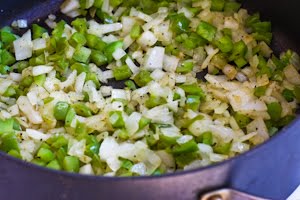
Stuffed Green Peppers with Brown Rice, Italian Sausage, and Parmesan found on KalynsKitchen.comRemove the stems, then chop up the pepper tops along with one large onion. I made this fairly small dice because I wanted it well-distributed in the rice.

Stuffed Green Peppers with Brown Rice, Italian Sausage, and Parmesan found on KalynsKitchen.comHeat olive oil, then saute the peppers and onions for 3-4 minutes, until they are starting to soften but aren't browned.

Stuffed Green Peppers with Brown Rice, Italian Sausage, and Parmesan found on KalynsKitchen.comRemove the peppers and onions, add a bit more olive oil, then squeeze the sausage out of the casings and saute until browned, breaking apart with the turner as you cook.

Stuffed Green Peppers with Brown Rice, Italian Sausage, and Parmesan found on KalynsKitchen.comAdd the onions and peppers back to the sausage, add dried spices and saute 2-3 minutes to blend the flavors.

Stuffed Green Peppers with Brown Rice, Italian Sausage, and Parmesan found on KalynsKitchen.comThen mix in the cooked brown rice and Parmesan cheese and cook 1-2 minutes to warm the mixture.

Stuffed Green Peppers with Brown Rice, Italian Sausage, and Parmesan found on KalynsKitchen.comStuff the filling mixture into the peppers, pushing down with a spoon so the peppers are tightly stuffed. (A few years ago I stopped pre-cooking the peppers before stuffing, and now I prefer peppers that are stuffed raw.) If you have peppers that are smaller than I did, you might have a bit of filling left. You can bake it in a small ramekin along with the peppers. Cook the stuffed peppers at 375 F/190C for about 30 minutes.

Stuffed Green Peppers with Brown Rice, Italian Sausage, and Parmesan found on KalynsKitchen.com
After 30 minutes, remove from oven and put a generous pinch of grated mozzarella on top of each pepper. (The filling might have shrunk down a little, making it easy to add the cheese.)
Stuffed Green Peppers with Brown Rice, Italian Sausage, and Parmesan found on KalynsKitchen.com
Put peppers back in the oven and bake 10-15 minutes more, or until cheese is melted and lightly browned. Serve hot.
Stuffed Green Peppers with Brown Rice, Italian Sausage, and Parmesan found on KalynsKitchen.com
Stuffed Green Peppers with Brown Rice, Italian Sausage, and Parmesan
(Makes 4 large stuffed green peppers, recipe created by Kalyn when her market had a great sale on peppers!)
Ingredients: 
1 C long-grain brown rice (I used Uncle Ben's Brown Rice, but any long-grain rice will work.)
4 large green bell peppers, bottom trimmed, cap end cut off and diced, and seeds removed
1 large onion, diced
2 tsp. + 1 tsp. olive oil
2 links (about 8 ounces) turkey Sweet Italian Sausage (or other sausage of your choice. Use diced mushrooms instead of sausage for vegetarian version.)
1/2 tsp. ground fennel
1/2 tsp. dried Greek or Turkish oregano
1/2 cup grated Parmesan cheese
salt and fresh ground black pepper to taste
1/4 cup grated mozzarella cheese
Instructions: 
Cook rice according to package directions, or using a rice cooker. (Rice can be cooked ahead and used in this recipe later.)Preheat oven to 375F/190C. Trim bottom of bell peppers so they have a flat surface to stand on. Cut off a fairly generous amount of the stem end of peppers, then remove seeds. Place hollowed-out peppers in a baking dish that you've sprayed with non-stick spray or olive oil. (A dish that's close in size to the peppers will work best.)Remove stem part from the pepper caps and trim off any white membrane, then dice pepper caps and the onion into fairly small dice. Heat 2 tsp. olive oil in a large skillet, then saute diced pepper and onion for 3-4 minutes, until they are starting to soften but aren't browned. Remove pepper-onion mixture to a bowl, add 1 tsp. more olive oil, then squeeze sausage out of the casing and cook until it's lightly browned, breaking apart with the back of the turner.Put the onion-pepper mixture back into the pan with the sausage, add the dried spices, and saute 2-3 minutes to blend the flavors. Then add cooked rice and Parmesan cheese, season the mixture with salt and fresh ground black pepper to taste, and cook just long enough to warm, about 1-2 minutes.Stuff the filling mixture into the hollowed-out peppers, using a spoon to press the mixture down so it's tightly packed into the pepper shell. (A few years ago I stopped pre-cooking the peppers before stuffing, and now I prefer peppers that are stuffed raw.) If you have any extra filling, you can put it in a small ramekin and bake along with the peppers. Bake peppers for 30 minutes, then remove from oven and put a generous pinch of grated mozzarella on top of each pepper. Put peppers back into the oven and bake about 10-15 minutes more, until cheese is melted and lightly browned. Serve hot.You can freeze leftover peppers for a month or two, although the frozen peppers will be a little softer in texture (but still very tasty.) I cut them in half top-to-bottom before freezing and freeze two halves in a small baking dish with a snap-on lid.